Bangladesh Environmentalist Society is a registered Non- Government and Non- Profit organisation with an aim to contribute in the welfare of the community and environment. The organisation is engaged in implementation of sustainable development goals with regards to environment, youth, women and social development through research, programs, projects, training in order to find sustainable solutions of social and environmental crises.
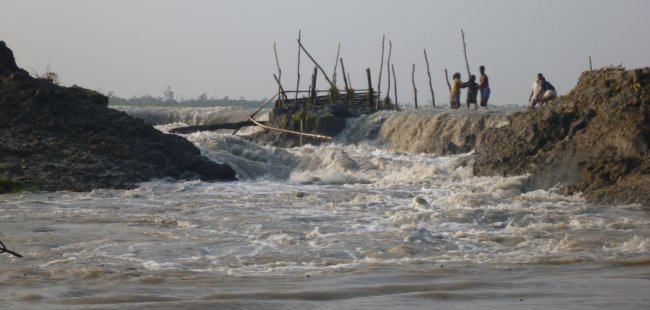
Sluice gates are built to control water flow across the embankment, both for draining and flooding the landscape at different times of the year. They are often used to provide saline water from the river to shrimp ponds. Many shrimp farms built additional sluice gates or modify the embankment to allow the exchange of salt water between channels and their ponds. Here, a weakened embankment was unable to withstand the storm surge caused by Cyclone Aila, leading to failure and flooding of the polder interior
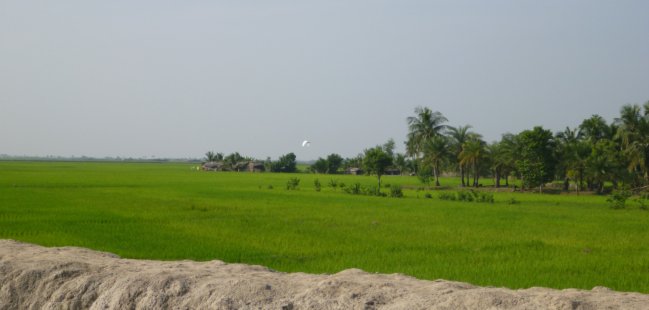
Rice paddy cultivation is a major source of livelihood in Bangladesh. Because the natural environment of Bangladesh is so well suited to rice farming, the country has been able to expand rice-production faster than population growth over recent decades, allowing for agricultural self-sufficiency despite having one of the world’s densest populations.
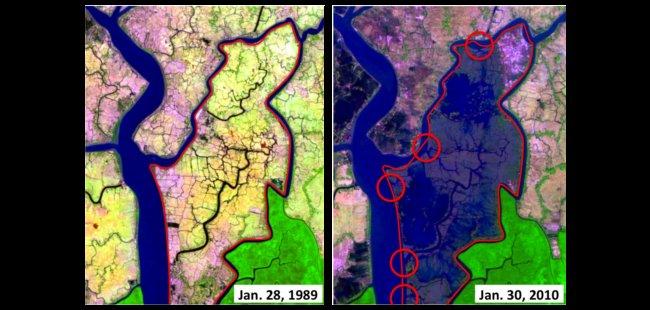
In 2009 Cyclone Aila caused five major embankment breaches, resulting in flooding of the majority of this polder. The 2010 LANDSAT image was taken 8 months after Cyclone Aila, showing most of the landscape wet or inundated by tidal waters. The red lines show the 1989 river-bank position, with the red circles denoting the location of the major breaches.